Out of step: growing up gifted and neurodivergent
Introduction
For more than forty years, I've felt as though I were living slightly out of step with everyone else, in a way no one could see.
As a child, the gap was clear enough to complicate my schooling and, later, my sleep and my relationships. Well… clear to me, but too blurry to be named and explained to anyone else.
First people talked about being an EIP (enfant intellectuellement précoce, an "intellectually precocious child"), then a high-potential child, then gifted, and now neurodivergent: an umbrella term that also covers other differences in how the brain works and processes information.
This article isn't a push to get a diagnosis, nor the typical story of someone whose brain is constantly in overdrive.
I'm simply going to tell you my story, with its ups and downs, the typical moments you may recognise yourself in, and the quirks that are mine alone.
Childhood: a promising giftedness diagnosis… that sealed my fate
EIP: the first word for my difference
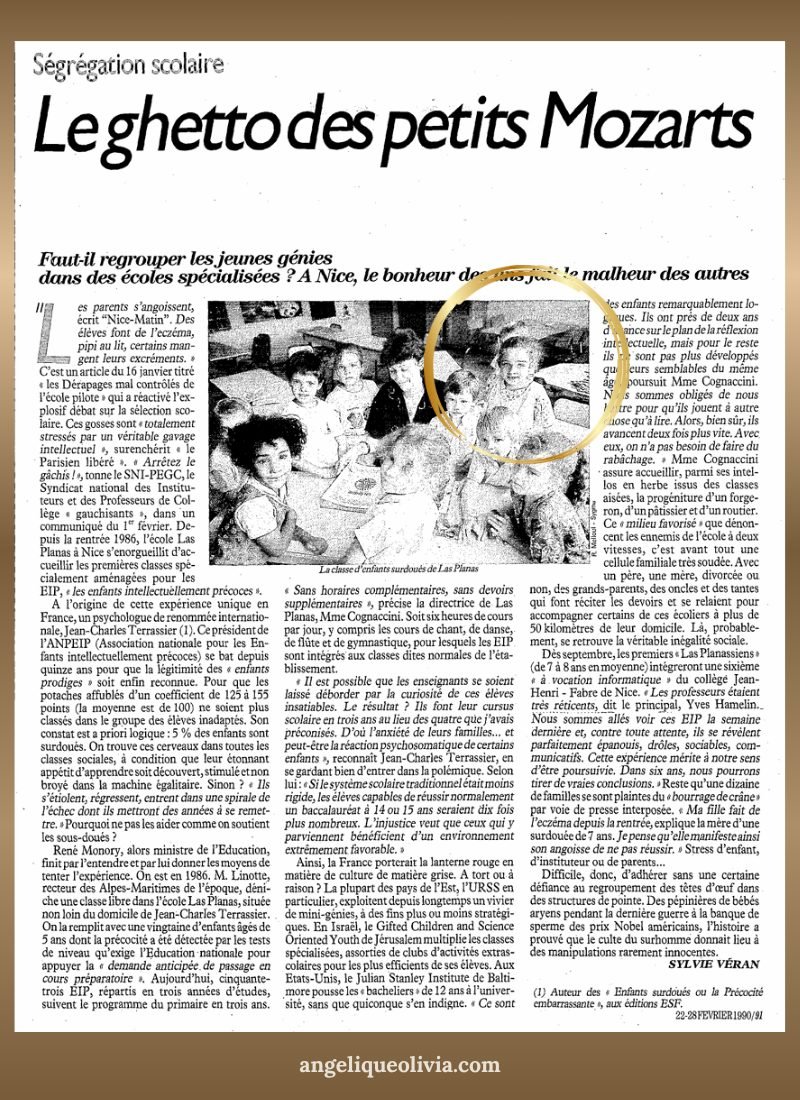
I was identified as an EIP at the age of five by Professor Jean-Charles Terrassier, former president of the ANPEIP (the French national association for intellectually precocious children), who had his practice in Nice.
What I remember most is a long series of questions that I answered without really understanding what was at stake.
I knew only one thing: I was unhappy, in general, and especially at school.
I started talking early, in full sentences almost straight away. My grandmother, who looked after me, encouraged me to read very early, at her kitchen table. Nose buried in the Boscher method, a classic French reading primer, I deciphered one syllable after another.
My mother heard my distress, had me skip a year of nursery school and took me to see Terrassier, who was setting up a pilot class for "gifted children".
I couldn't blame her. I could read fluently and I was hungry for culture… but I spent my days sticking on stickers and cutting out shapes with sewing needles, because we weren't allowed scissors.
IQ test: the first crack in my relationship with giftedness
As a teenager (around 13, if I remember rightly), I went back to Terrassier to retake an IQ test. I was struggling to choose my path in première, the penultimate year of the French lycée, and had sunk into panic attacks and depression.
They put me in a room and handed me a booklet of tests. At first, it's easy: you guess the missing domino after a series of three, then four. Soon, you find yourself filling the gaps in complex rosettes.
I passed the test easily, without overthinking it, already weighed down by my other worries.
Unsurprisingly, the final number hadn't changed radically, but something had cracked in my relationship with my giftedness, and in my trust in this professor, whom I hadn't really seen since early childhood.
Cultural capital: when performance drowns out listening
In the interviews that followed, I didn't feel heard on a personal level. The solution offered – the IQ test – had nothing to do with the problems I was experiencing on an everyday basis. I had the distinct feeling that everything came down to performance, with no tolerance whatsoever for "weakness".
Faced with my excellent results in the non-verbal tests (apparently, I'm brilliant at visualising in 3D), the professor tried to persuade me to stay in the science stream, when I sensed I would flourish far more in the literature stream, even if it meant repeating a year.
He also asked me about concepts and historical facts that (I quote) "everyone should know", even though we hadn't covered them in class yet.
No, Professor, not every family has the same cultural capital.
I felt put in the hot seat, one built by my social class and by arbitrary rules.
Another anecdote reinforced my class complex: the third time I went to see him, a few years later, I came across a child in the waiting room with his nanny, who was speaking to him in English to teach him the language. Much later, once I was mature enough to step back, I remember thinking: so that's who I was made to compete with all my life, especially when I was advised to apply for hypokhâgne, the elite preparatory class for the humanities (I'd never even heard the word).
And people wonder why I'm stressed…
Specialised schooling: an encouraging framework… that also hemmed me in
Let's go back to 1987.
Having sailed through the test, I was first in line to be a guinea pig.
Terrassier was the driving force behind specialised classes for so-called gifted children. And believe me, competition was fierce to get into this pilot class, the only chance to receive this kind of teaching in the state system.
(To meet demand, other classes had already been set up at Michelet, another school in Nice – a private one, this time.)
Las Planas: a unique pilot school in the state sector
So my specialised schooling took place at Las Planas state primary school in Nice-Nord (a neighbourhood close to home, but "a bit rough"), from my very first year of primary school. Day to day, we were a class led by a specialist teacher, Michelle Brignone, who had previously worked with disabled children. Children from outside the catchment area, identified as gifted or well ahead at school, had joined our small group tested by Terrassier.
On the whole, I was happy.
The days overflowed with activities and I could read as much as I liked, which seemed to me the school's main advantage.
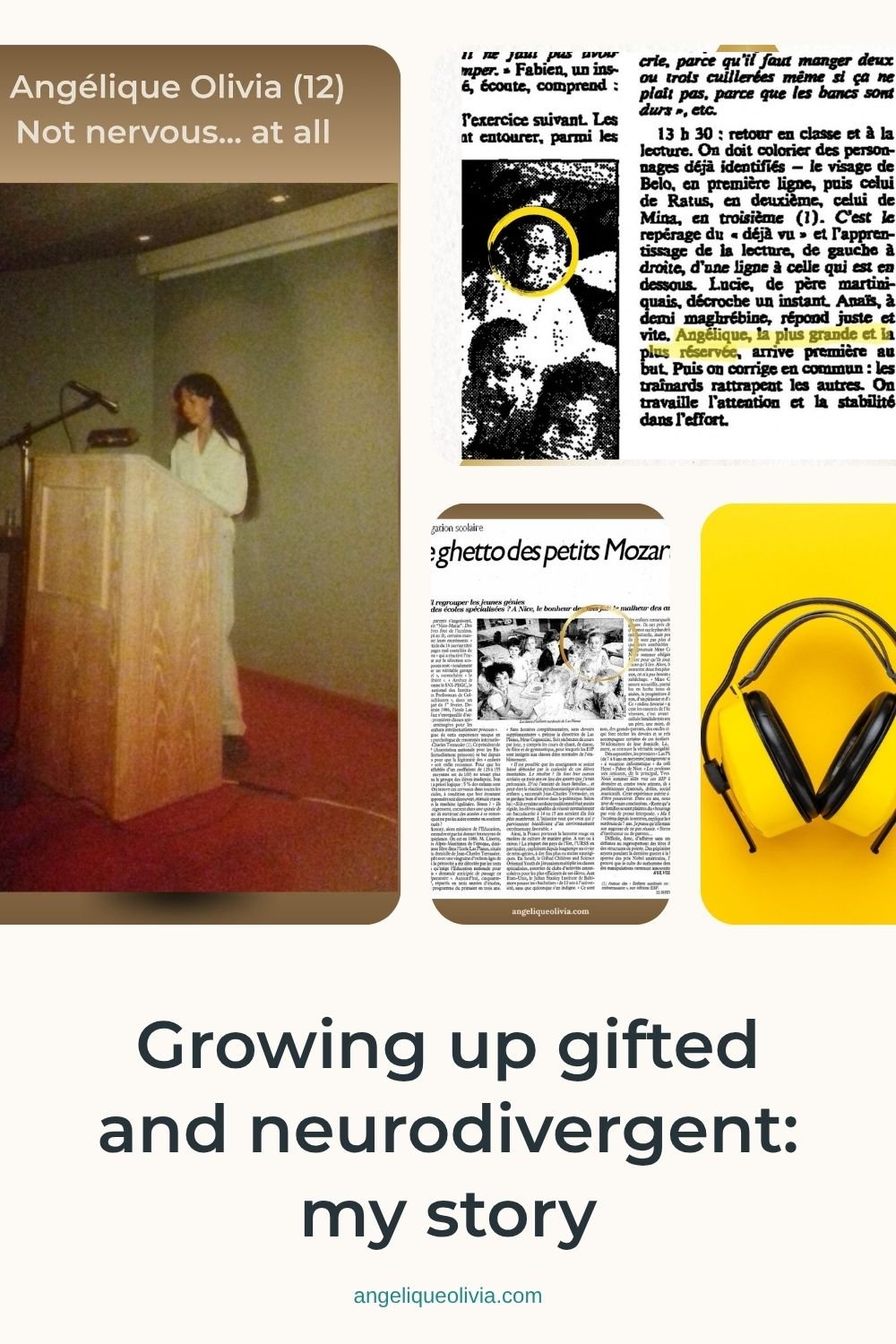
Here's what Danielle Rouard wrote about me in Le Monde on 24 September 1987.
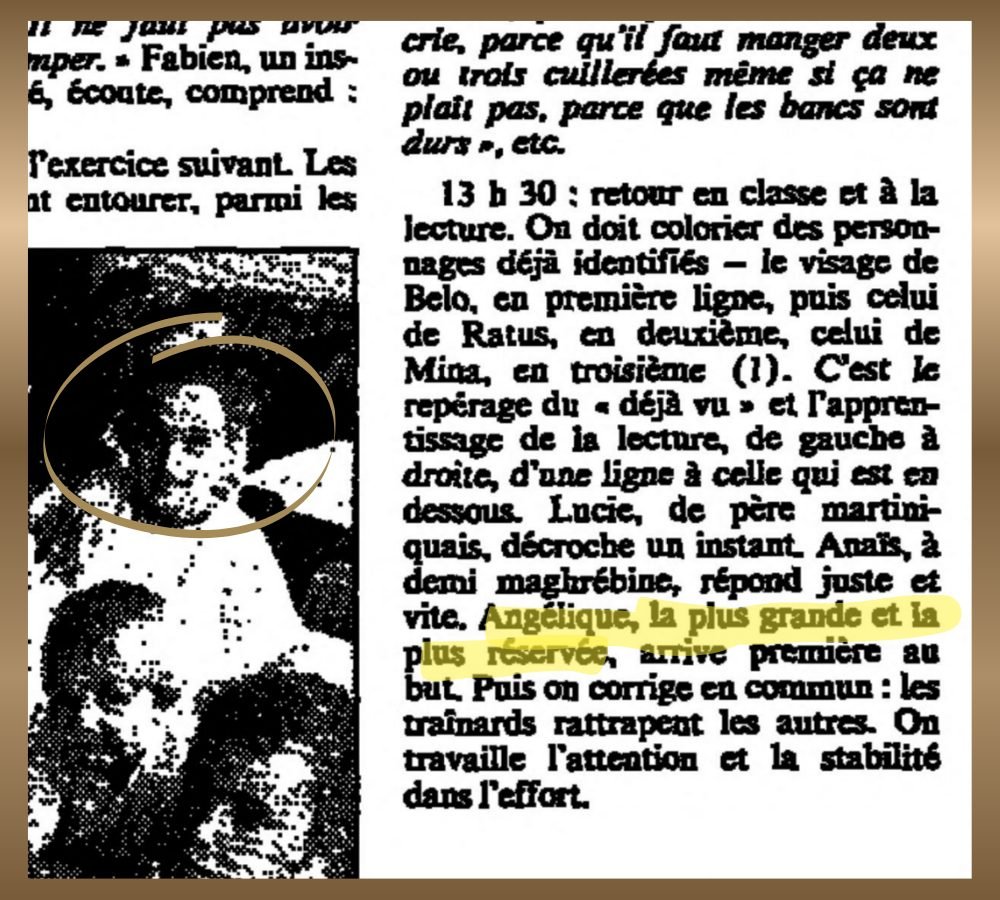
From those years, I remember my almost inseparable friendship with a boy who was as creative as I was, the end-of-year show (an adaptation of Alphonse Daudet's The Secret of Master Cornille), fire-safety training at the Col d'Èze… and going back to my grandmother's to sit in front of the television, hooked on Star Trek or Spartakus and the Sun Beneath the Sea.
An idyllic picture.
Still, it left its scars.
In the first year, we could sit wherever we liked, like most children. Then, gradually, we were seated according to our marks. I ended up in the first column, but never at the front. Looking back, it was extremely stressful and it affected me, if only unconsciously. I think it's also why I feel better sitting on the left-hand side of a room, as close as possible to the board: as if my body were still looking for a safe place that validates me, without my being able to put it into words for many years.
That said, I'm deeply grateful for all the educational opportunities I was given.
Fantastic educational opportunities
Let's admit it, this path had some exciting sides:
- cultural activities,
- trips to the theatre,
- arts and crafts,
- an introduction to English and computing.
Later, other classes were created (we were the pioneers), offering, for example, a European section with extra modern language lessons.
At Henri Fabre secondary school, many of the Las Planas pupils, along with others selected on application, were grouped together in the class nicknamed "the Big Heads", with a computing option and extra science lessons (physics, chemistry and technology) from the very first year.
Later, driven by our French teacher, Marie-France Poirée, we won a writing competition that took us all the way to the Paris Book Fair to meet our patron. Then we self-published our story: a founding moment that fed my ambitions as a writer very early on. My first publication was therefore a quarter of a chapter I wrote for Où sont passées les vacances ? ("Where did the holidays go?").
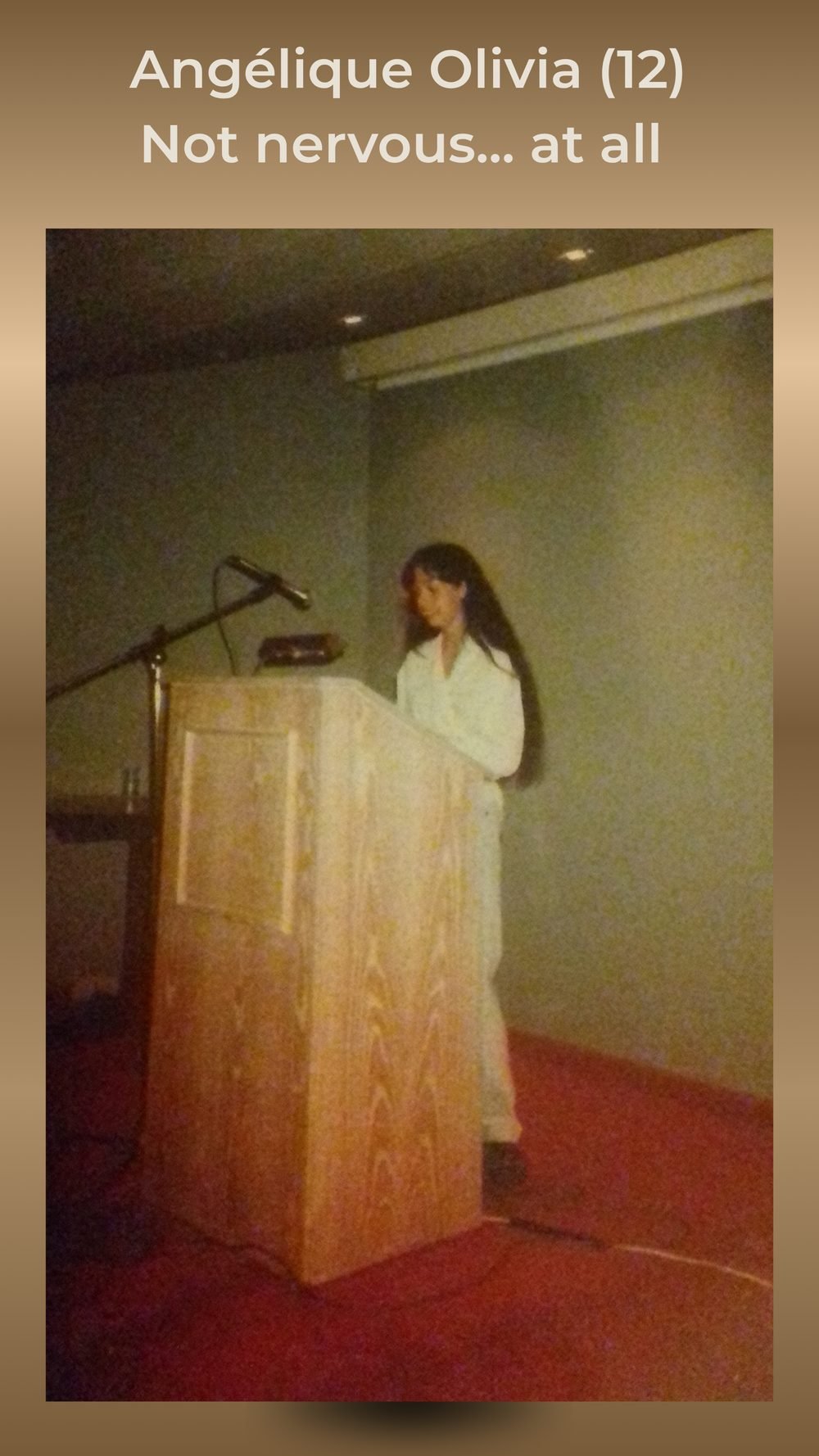
Here I am presenting our work to our teachers, our parents, our sponsors and several local political figures at a gala evening held in a grand hotel in Nice.
However, this framework came at a cost.
Staying in the same group gave me landmarks. At the same time, it kept me from fitting in anywhere else. I was lucky enough to make friends by chance in the playground, and I admit I would rather have been in class with them than stay in a group chosen in advance, which I remained in for several years in a row, right up to première S (the science stream).
When you don't form strong bonds from the start, it's a long and painful process.
And above all, it doesn't teach you how to socialise.
Learning too fast… without learning how to learn
The trap: learning fast, with no study method
Another, more insidious effect of my time in a specialised class was learning too quickly.
When you understand quickly, you can go for years without developing a study method.
That was my case.
After staying around the class average (while still three years ahead), I repeated my première year and changed schools.
That's when I woke up to the work.
I started spending much more time at my desk, learning my lessons, doing extra reading.
Except I fell into the other extreme. I found it hard to hold back. I often spent half the night devouring culture… without really knowing how to take notes, structure knowledge or reproduce it in tests.
So yes, I spoke English fluently at a very young age and had a vast literary culture, but my health took a hit.
Overperformance: fertile ground for burnout
In prépa (the two-year preparatory classes for France's most selective schools — I did only one year), it wasn't unusual for me to work 80 to 100 hours a week. Sitting at my desk, admittedly, but work all the same. I was sixteen and usually slept three or four hours a night. I was constantly stressed.
The age gap: a concrete, sometimes brutal impact
The age gap (three years ahead until première S) had a strong impact at puberty, because mine came a little too early. I easily looked several years older. A circumstance that, sadly, exposed me to certain behaviours, particularly from men, that I could well have done without.
Then came a concrete realisation: even though I soaked everything up like a sponge, students of the usual age had, in practice, had up to three more years to absorb the same knowledge. Can you see my burnout looming as I fought to keep up with them?
At university, the difference became more visible, but in other ways. Having passed my baccalauréat at sixteen, I attended lectures alongside young adults returning to study after a first job, who were already 23 when I was 17. In those situations, my sometimes slightly offbeat, usually very naïve behaviour set me apart. And although we had the same student status, I wasn't allowed to sign a normal employment contract, to open a bank account or to handle most paperwork in my own name.
My (possible) neurodivergence diagnosis: shifting ground
Neurodivergence: the diagnosis moves, the experience remains
Since then, I've thought a great deal about my giftedness. I've read up on it to find solutions for everything that didn't fit the mould and was making my life a misery.
If you're a neurodivergent woman who has slipped through the net all your life, you'll understand: a diagnosis isn't a fixed destination but a shifting framework. I feel as though the criteria and the terminology change every five years.
Trauma or wiring: a hard line to draw
My main problem: working out what came from various traumas and what came from the very structure of my brain.
For example, after spending time around a narcissistic person who fed on my humiliation, I learnt to keep a straight face so as not to let any of my emotions show. So I don't know whether my face being too expressive, or sometimes not expressive enough, is down to my brain or to a behaviour I had to adopt to survive.
I was also in a very serious car accident in 2006, in which the driver of the other car lost his life. My nervousness in cars and the avoidance strategies that followed have more to do with trauma than with a simple sensitivity to noise or to crowds on public transport. Well… I think.
Then there's a wider context: growing up, and later living, in a modest and sometimes precarious environment, to the point of finding myself on the verge of collapse several times, doesn't help you feel safe. And when your body doesn't feel safe, your nervous system goes into overdrive.
In practice, in 2009, I was assessed for Asperger's syndrome (is that term even still used?).
Unfortunately, I left the UK before getting the final result.
I do remember several interviews, spread over an entire season. During one of them, the psychologist's phone started ringing in her bag, right next to me. I took it for the jingle of the ice-cream van outside in the street. A difficulty locating sounds in space is typical of neurodivergent women… Telling, isn't it?
"I don't have the same problems as other people"
With no easily diagnosable criteria, the realisation was gradual. As long as I could mask, it stayed manageable. And above all, I didn't know I was masking: I was just getting by. It was my normal.
I think back to a list of very concrete clues.
Sensitivities and short circuits: very concrete clues
- First, there's sensitivity to noise, especially electrical or repetitive sounds.
- Difficulty falling asleep, too.
- Extreme stress, which I thought was due solely to my family environment, but which didn't go away when I changed surroundings.
- And then extremely vivid dreams. I've only slept like a log about five times in my life, two of them under general anaesthetic. Sometimes I'm already exhausted at the thought of falling asleep, because I know my mind will be moving through something like virtual reality: extremely precise, sometimes very stressful, and not necessarily gone when I wake up.
- There are also emotional short circuits. I remember a classmate at school telling me about her father, who was in hospital. I sincerely sympathised… but I laughed. As if the emotion had got it wrong when trying to activate the muscles of my face. That face which, as I said, I didn't move much.
- Finally, I find it hard to tell where sounds are coming from or how far away they are. At work, in a noisy environment, if my phone screen doesn't light up, I don't know it's the one ringing. In the same office, an old, noisy printer gave me terrible headaches. Flickering strip lights or a colleague with a very high-pitched voice who talked non-stop could trigger immediate, stubborn migraines.
Masking: staying upright… in silence
Looking back, my masking strategies were simple: I didn't talk about it.
I thought functioning on very little sleep was normal.
I never told my teachers that the sun reflecting off the white page I was taking notes on left me almost blind and unable to read the board.
I took refuge in the silence of a library instead of socialising.
The cost was measured in health and in lost human connections.
Two signs impossible to ignore
If I had to pick two signs that were impossible to ignore, they would be these:
- difficulty falling asleep (with the tiredness that builds up),
- and being unable to keep my space clean and organised, with direct effects on hygiene and meals.
Overperforming at work, as long as human contact remained limited, didn't make up for how hard it was to manage daily life in private. My unmanaged mental load ended up swallowing everything else.
The impact today: scattered attention
Body and environment: clumsiness, clothes, visual overload
In my private life, the effects of my neurodivergence are sometimes very practical.
I can't drive. Above a certain speed, I go into sensory overload or fall asleep. Riding even an electric scooter for 600 metres takes so much concentration that I often have to lie down afterwards.
When I was younger, I often fell off my bike. The first time I had a bike with gears, I was so fascinated by my back wheel that I nearly ended up in a ditch.
I'm very clumsy (although I'm working on it through workouts based on repetitive movements).
I don't tolerate some clothes well. Scratchy labels are my sworn enemy.
I go into visual overload as soon as the space around me is too full.
When I was younger, I found it hard to go to concerts or shows with strobe lights, and my tolerance has only declined over the years.
I also feel better when I cut down on lactose, casein, gluten and sugar, which makes my culinary life duller than I'd like.
Distraction: daily life in pieces
Distraction, meanwhile, is everywhere.
I prefer working in split screen.
Switching tabs to look something up breaks my flow. Like many people these days, I can disappear down a Google rabbit hole or forget what I wanted to look up.
In the kitchen, I have to be very careful: I'm quite capable of forgetting there's something on the hob. I'm grateful to live in a small space where I can hear the pan cooking, because as a young adult on the verge of burnout, I once went out to the chemist's or the supermarket and left the gas on.
I also have to write down what I take, so that I don't take my medication twice.
Sometimes I go to have my evening shower and realise I've already had it when I walk into the bathroom and soak my socks on the still-wet floor.
It's extremely infantilising day to day, and shame kept me from talking about it.
Tools that keep me on track: Pomodoro and "Study with Me"
My best tool for avoiding distraction accidents is a timer, often set to a double Pomodoro session (50 minutes of work / 10 minutes' break).
It creates a sense of urgency, admittedly, but one that doesn't stress me.
During COVID, and later on, I discovered "Study with Me" videos on YouTube.
I sometimes keep one playing in the background or on a second screen, like a presence that keeps me on track without distracting me.
I often work in front of my window. If I feel my neighbours can see me, I let myself get distracted less.
Still, it's exhausting, because I feel as though I spend more time managing my concentration to stop my life falling apart than actually creating.
Minimalism: reducing mental load
A radical solution: I've adopted minimalism in many areas of my life (physical and digital) to reduce my mental load. The organisation system I'm building was born of this necessity. I introduce the methods that inspired it in my article Classification systems for getting organised.
Sensory overload: noise as a trigger
When it comes to overload, my most painful triggers are noises.
I spend a good part of my life with earplugs or noise-cancelling headphones within reach.
My building is noisy: I don't necessarily hear my neighbours talking, but the washing machines, the tumble dryers and the air rushing through the ventilation pipes all keep me from relaxing. As soon as I can, I'll move.
We've come a long way from the giftedness this article opened with, haven't we?
Conclusion: no fixed diagnosis, but a voice I hope is legitimate
What I know, beyond labels
Today, I'm not looking for a precise diagnosis. I can't always tell what comes from my brain's particular biochemistry and what stems from traumatic experiences. But I can recognise what I've lived through and the effects it has had on my daily life.
I feel for neurodivergent women, and for those who create a great deal, professionally or personally, while carrying a massive mental load. Without setting myself up as an expert, I believe we can talk to each other as equals.
If I had to pass on three ideas, even before any diagnosis, they would be these:
- Map every area of your life, to look your mental load in the eye
- Let go of avoidance strategies, which sometimes cost more than the life they're supposed to protect
- And learn to value yourself when everything pushes you towards self-blame.
What I'd like you to feel as you read this is the empathy I feel for you, and then relief: the relief of being seen, without being reduced to a label.
Going further
I'm writing a memoir to help me put words to my experience. I think it could be useful to other neurodivergent people, especially women.
Do you represent a publisher specialising in these issues? Send me a message. I'd be delighted to start a conversation in writing and send you a presentation of my project. The first draft will be written in French, but I'm open to working with an English-language writer.

Angélique Olivia MoreauLinguist and translator based in Bergen, Norway — building bridges between languages, culture and the way we organise our lives.